

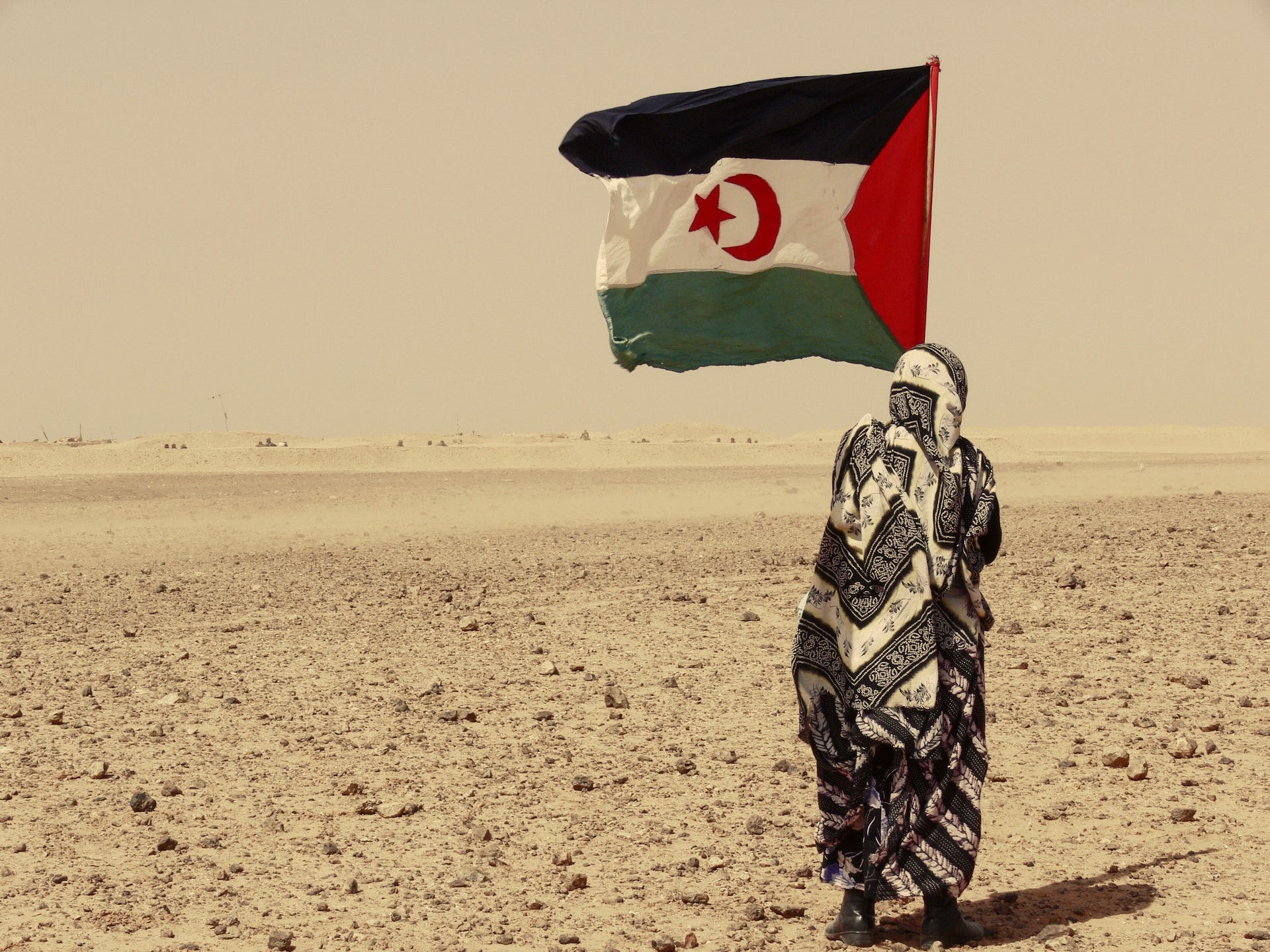
When I was little, I had a sheep in the Sahara.
Many times, my parents asked me if I wanted to go and see her one day, since I did not live there, and I would tell them yes. That I would like to, someday. But I never asked myself why I had a sheep in the Sahara, or why it mattered to me to own something I had never seen.
A sheep is a soft, woolly animal. Something you can almost fluff beneath the weight of your hands. And yet, to me, a sheep was simply something invisible, something that existed somewhere in the Sahara, thousands of kilometres from my home in Europe.
I had a sheep, but I never really stopped to wonder what I wanted with a sheep I had never seen. Why do we want things? Why do we desire something simply because we know that it belongs to us? Perhaps for some future flock, or sometimes because that something settles deep inside us and becomes an anchor tying us to our past.
Everything we desire. Everything we do not know.
How would I know how to look after that sheep? The heat of the Sahara must be unbearable. And what would I do when I couldn’t speak Arabic? I had never lived away from home. A seven-year-old boy with his sheep in the Sahara?
“I’m sorry, Daniel. I’ve sold her.”
“Why?”
“Well, she was already very old.”
“But... you told me she was my sheep.”
“Yes, but don’t worry. When you come, you’ll have another one.”
“Will you send me pictures of her when you go back?”
“Of course.”
L. smiled. And I still didn’t understand why I would always have a new sheep in the Sahara. I didn’t understand why he would sell her either. To be honest, I didn’t even know where El Aaiún was, L.’s home. I didn’t understand why he came to visit us once a year from Germany. Nor did I understand what connected L. to my family.
El Aaiún is a city in Western Sahara.
And Western Sahara is... well, it isn’t.
It is something like the sheep.
The history of the desert is older than the sky, and throughout the centuries men, civilisations, power and rain appear and disappear. The forces of humanity and the weaknesses of nature. All of it contained within a grain of sand.
I think my uncle must have thought something similar when, in the early 1970s, he was sent to Western Sahara as a teacher. He had been born in the former Protectorate, and now he had been sent to the fifty-third province of the Spanish state.
Western Sahara was, at the time, a province, and as such Spanish authorities and their citizens inhabited places that children like L. believed to be far removed from the words being spoken far from the desert, in the baroque and gloomy offices of Madrid, Paris, Tangier, Washington and Algiers.
On 6 November 1975, a great cloud of dust swept across the Sahara. I suppose that, at that moment, the sounds of the Green March had not yet reached the school my uncle and L. shared, teacher and pupil respectively. The great cloud of the Green March was a testimony, a swan song for one colonial power and a great leap of faith into the future for another colonial power. For L., as for many other Sahrawis, that November day would be one of the first last days of his youth. Weeks later, he would no longer return to school, nor would my uncle. The Spanish authorities abandoned the Sahara. My uncle saw the desert for the last time from a ship bound for the Canary Islands while Moroccan and Mauritanian authorities divided and occupied the territory, arresting many Sahrawis, including L.
The connections between a schoolboy and the Polisario Front or the Sahrawi Liberation Movement did not need to be proven, because the destruction of a place’s childhood is also the destruction of its future. The imprisonment and subsequent expulsion of its citizens would turn the idea of creating a Sahrawi Arab Democratic Republic into nothing more than another mirage in the desert. Beyond the negotiating tables and the expulsions, one thing was clear: L. was in prison, like many other Sahrawis. My uncle was expelled to Europe. Both of them left the Sahara.
Europe, despite its proximity, has traditionally isolated itself spiritually from Africa, only reaching its hands through the window when necessary, or opening the peephole to see what was happening without responding. The Old Continent fell silent when the mother continent became an inconvenient and noisy neighbour that would not allow it to rest in its European garden. In 2022, Josep Borrell, the EU’s foreign policy chief, compared the European Union to a “garden” and the rest of the world to a “jungle”. The African jungle and the European garden looked at one another. The jungle threatened to destroy the beautiful botanical parks and the perfect, black and frozen waters Rimbaud once wrote about; meanwhile, the garden closed itself off more and more, and its lush gates were also made from African materials.
I have often wondered what happened during those decades when L. was held in a Moroccan prison. What went through his head? How did he experience it? Did the turmoil of occupation and war also exist inside the prison? Because displacement existed both inside and outside its walls.
Years later, I learned that, after being released, now a grown man, he began travelling to Germany. There, he would buy second-hand cars and drive them across Europe to El Aaiún, where he would sell them. There, in the Saharan city, he married and had children.
El Aaiún is the de jure capital of the Sahrawi Arab Democratic Republic.
Tifariti is the provisional capital of the Sahrawi Arab Democratic Republic.Rabouni is its capital in exile.
As for me, I did not discover any of this until I was well into my adolescence, roughly the same age at which he had been imprisoned. We never spoke about any of it when he came to visit us. We talked about the journey, the French roads, the snow at the border, his family, how much I had grown and, of course, the sheep.
Meanwhile, far away from Europe, in Tindouf, Algeria, his fellow Sahrawis remained and remain isolated by a great wall of landmines built by the Moroccan state decades ago. The Sahrawi people are divided by that long wall cutting across the desert.
I think it is easy to build walls in the desert, but not around its people. Perhaps that is why the Sahrawi Arab Democratic Republic has endured on the margins of History for so long, waiting for its day to come.
“Well, I’m afraid I have to get going. It’s getting late.”
“Come back and visit us soon.”
“Of course. I’ll call you when I’m back around here.”
“Next time, you could bring the sheep so I can see her.”
“I’m sorry, Daniel. I think it would be better if you came to see her.”
“You see, the sheep was born in the Sahara, and she wouldn’t be happy if she wasn’t there with her family.”
“Of course. Poor sheep.”
“Well, you’ll come one day. I’ll send you pictures of the new sheep. She’s very bouncy!”
“Thank you.”
“Well, everyone, see you soon!”
“Have a good journey!”
I think I understand better now what he meant. So often, we carry the worlds in which we grew up and learn how to live deep inside us, so deeply that they become as important as a heart or a body. And so often, the most intimate part of our world is everything we are and everything we carry with us without ever saying it, almost like the desert.