

I left home because I thought it would still be there when I came back.
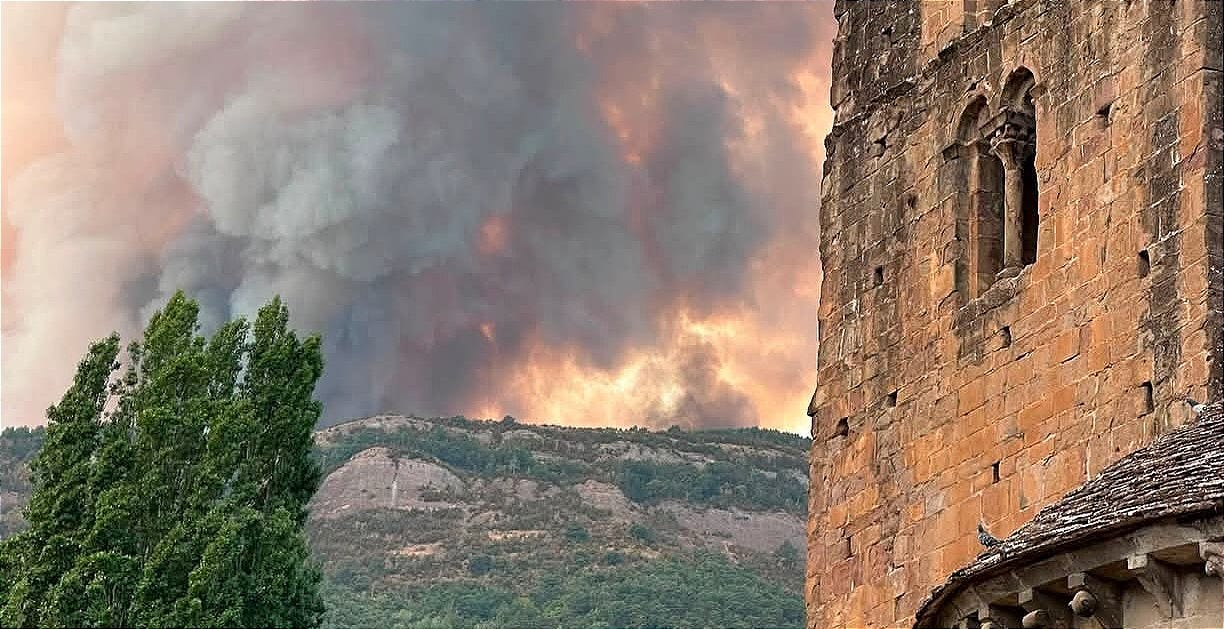
And now, a decade later, I am standing before a burning Aragonese landscape.
More than a landscape, it is a memory. It is the sacred, cold drop that numbs my face on an October morning. It is like a badly rooted habit. A photograph of my grandfather, whom I never knew, standing on the battlements of a castle in his black beret and black jumper. It is a mountain house where the only inhabitants are the ashes disappearing into the wind outside on the hillside. My family has always had the custom of giving the ashes back to the wind when someone dies.
It is my past.
And the fire standing before it. What remains of myself is inside that fire.
And it is burning again.
A week ago, on Monday, 10 August 2026, a fire broke out in the area of Riglos, back in Aragon, in northern Spain. My grandfather’s mountain cottage is just behind the river that cuts vertically and deeply through the gorge separating Riglos from Agüero, jumping between the cliffs and climbing through the woods until it reaches Luenga Peak.
I have lived in that place. When I was little, my father would take me there to learn how to climb those vertical walls. Years later, I would cross the outline of the frozen river and the transparency of the yellow leaves of late autumn to travel to and from Paris on the train that reaches the border. After the tunnel, the ravines and peaks unfold, the train slows down and moves along the contours of the reservoir. My father also travelled on that train, when its speed was once so slow that you could get off and back onto it without losing your breath as it crossed the avenue of iron lined with the wet trees of the pond. On that train, both then and now, all my years are there, outside and inside.
The fire is out of control.
How can I remember somewhere that is disappearing?
How can I remember myself when I am disappearing too?
A few days ago, the fire threatened the surrounding villages and their inhabitants were evacuated. The remains of the Aragonese kings buried in the ancient monastery of San Juan were evacuated too, and like everyone else, the loss is more than everything we can see.
The past has been saved, the present has been halted, and the future has dissipated.
The most absolute loss is fire.
An Ash Wednesday, similar to the one T. S. Eliot described.
It is not only all of this that goes into the fire, everything we have lost among the forests and the animals. It is also the first circumstantial wound of a long walk, the inexplicable vertigo of the fall, the weight of winter and of the years crushed beneath the railway tracks, memory, time, exile, madness, French crossword puzzles, uncomfortable and private questions, escape, fear, half of indifference, return.
I am also in the fire: an eight-year-old boy, somewhat sad, at a funeral, sitting in my grandfather’s house while my parents scatter the ashes and the wind carries all the memories away.
In the fire are the red clouds flying over the river and staining it red.
The ashes fall upon the French peaks, kilometres away.
All the memory of everything I have ever been.
The fire has changed, and so have I.
I am afraid that, for me, everything may have been lost.
Who creates a human being, if not their time? And what is important to remember from that time? What places have the right, or the power, to remember who we were, to imagine what we will become?
The fire has taken my memories. Any of them.
It is like looking through the window of a train inside a tunnel, and in your reflection, covered in light, being unable to recognise yourself.