

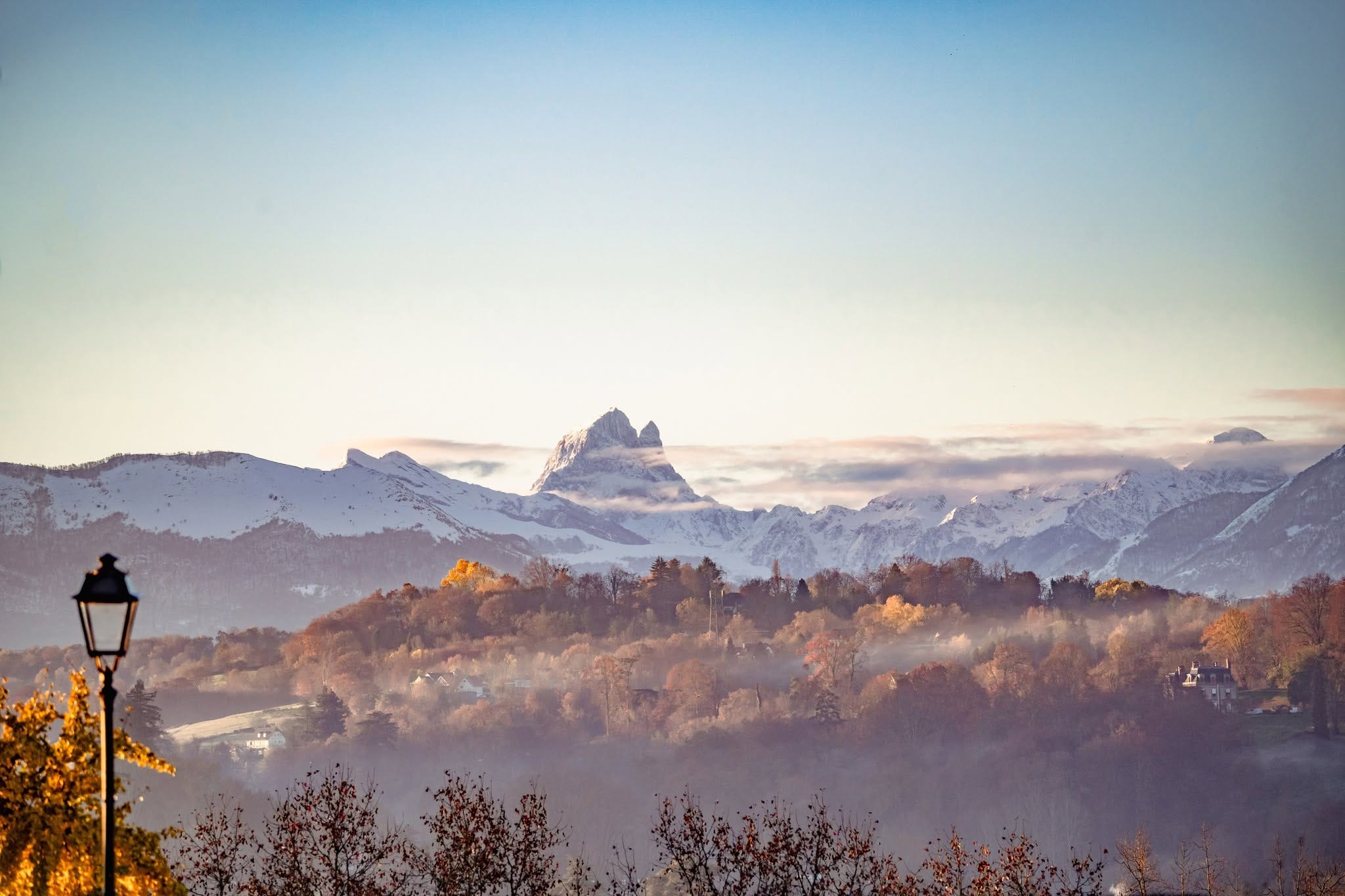
Some summers, winter strikes again.
There, at the end of the alleyway. It is like most things: unattended. The wind, and all the sacred things that come with it.
What I remember about wintertime France was not the cold, nor the rain. It was the loneliness that seemed to scratch at the façades, no matter how hard I tried to escape it; the loneliness dripping from windows, no matter how hard I tried to gather my bones and carry myself towards the ochre sunset.
Winter used to be the season of comfort.
I say “used to be” because, I reckon, I always enjoyed crushing the dry leaves beneath my feet, mixing and stirring them into a colourful broken puzzle until a sudden blow of air would take them away from me.
I used to be a poet in wintertime France.
A sunken poet in the muddy woods of some provincial road, trying to escape from myself and everything else.
In the humid Atlantic south of France, between the Basque coast and the high valleys of the Pyrenees, lay the small Béarnese city where I lived.
Many afternoons, I would return to my little studio there. The fragile purple contrasts of the Pyrenees, marking the French border, showed me the double, sickly colours of the horizon. Beyond the snow was the country where I had been born; here, the yellowish reflection of the sunset seemed to have been torn from the mountains and placed inside my eyes.
The railway station melted into winter and gathered the tears of ice-covered branches hanging from the Empire-style roofs. Two French tricolours fluttered above them, superimposed against the sunset.
They were worn.
As worn as the country.
Pau was provincial, sleepy and, to me at least, almost painfully boring. It was not, in fact, a rich city. Today, almost a quarter of its population lives below the poverty line, a striking figure in a region that can otherwise appear prosperous beneath the mountains.
And yet this was Béarn, a region whose landscape had once been transformed by the enormous wealth of the Lacq gas field.
The contradiction stayed with me.
A small city beneath the Pyrenees, apparently comfortable and unremarkable, carrying a history of industrial wealth and yet, at the railway station, people were sleeping because they had nowhere else to go.
I remember finding this difficult to understand.
Perhaps nowhere is not the absence of wealth.
Perhaps nowhere is what happens when wealth, housing and belonging stop belonging to the same place.
Every time I stepped down from the train, covered in melting snow, every time my feet struck the worn, grey floors of the station, I thought of my mother’s smile.
I thought, too, about the fact that one day those journeys home, and that smile upon returning to the only true homeland - or matria, the person from whom you are born - would come to an abrupt and unforeseen end, simply because all things are mortal.
All those strange winter journeys, while rain fell somewhere far away over the mountain peaks, would one day no longer be necessary. There would be nowhere to go, nowhere to return to.
The only constant was the mountains.
My life among them would slowly unravel.
I wanted to catch the exact second when the train turned sharply towards the depths of the valley. I wanted to capture the certainty that there would always be a smile waiting at the end of the journey, a pair of intense eyes listening for the sound of the keys and the half-open door, where footsteps were recognised without effort.
I wanted that cold, safe station to always exist, too — so safe that it could become almost oppressive.
The smell of embers scattered through the chimneys of French homes.
The winter light.
The mountains.
And, ultimately, a house.
When I returned to France after the winter holidays, I stepped off the train and saw the SDF.
Sans domicile fixe.
Another acronym among so many others, the kind that governments produce to make misfortune administratively manageable.
People without a fixed address.
People without a fixed home.
People without somewhere to return to.
The French state speaks often of its republican values, of liberty, equality and fraternity. Yet some citizens seem to matter more than others.
Some citizens are not necessary to cities.
Some people become inconvenient when they no longer participate in the productive and consumer fabric of society.
And some of those people become citizens of the station.
This is not a new idea. Much has been written about the way cities defend themselves against the people they no longer want: hostile architecture, benches designed so that nobody can sleep on them, spaces made uncomfortable enough to keep certain bodies moving.
We could talk about the benches of Camden in London, United Kingdom.
We could talk about the Tchaikovsky broadcast through the platforms of suburban Høje Taastrup in Zealand, Denmark, discouraging people from lingering.
We could talk about the sharp, jagged silhouettes of the shops around the Gare de Lyon in Paris.
We could talk about all of it.
But this is Pau.
A small, boring provincial city in the outer reaches of the French state, where the most exciting thing that can happen is watching a horse escape through the streets or an otter drift down the current of the gave, as the rivers are called around there.
And perhaps that is precisely why I noticed.
There was nothing spectacular about it.
No enormous metropolis.
No sprawling slum.
No spectacular skyline hiding spectacular inequality.
Just a small city beneath the mountains, and people sleeping inside its railway station.
The threat of capital is homelessness.
The promise of “humanising” work becomes, in the end, the dehumanisation of the non-inhabitant — the invisibility of those who no longer have a recognised place within the spaces we have built for ourselves.
Perhaps this is one of the fears that capitalism and the state quietly propose to us:
You could end up like them, too.
It is an old form of social control. Keep moving. Keep working. Keep consuming. Keep your rent paid. Keep your door closed.
Otherwise, you might become one of them.
A variation of Sartre’s “hell is other people”, perhaps.
Except that otherness has never been foreign to me.
Not even here.
Not even in this station.
I am a stranger too - a stranger with a foreign roof over my head, one that I pay for by answering to the demands of the French state.
The difference was simply that I had somewhere else to go.
The footsteps around me quickened.
The city’s funicular had already gone to sleep. Railway workers played with the keys to the carriages, while the station agents, dressed in their strangely decadent railway kepis, called out to me:
“Eh! Dépêche-toi! La gare va fermer!”
I had never realised that a station made up of two platforms and a tunnel could close.
“Okay, okay, j’arrive.”
I left the territory of the station with my empty backpack.
I had brought nothing from home except cigarettes.
I don’t think I needed anything else.
The station closed behind me.
Outside, Pau continued to exist exactly as it always had.
The mountains remained where they were.
The lights came on in the windows.
Somewhere, someone returned home.
Somewhere else, someone had nowhere to go.
This is a story of winter in France, but it has also been a story of Malmö, a story of Tokyo, a story of Cape Town, a story of everywhere, and of nowhere.
Because nowhere is not necessarily a place.
Sometimes it is a condition.
Sometimes it is the absence of a door.
Sometimes it is the space between being allowed to belong somewhere and being asked to leave.
And sometimes it is a railway station after midnight, when the lights are going out and the last people are being told to move along.
I used to think that winter was comforting because everything seemed to disappear beneath it.
The roads became empty.
The mountains became distant.
The world became quieter.
Now I wonder whether winter only makes visible what was already there.
The people sleeping beneath the station roofs.
The homes we are afraid of losing.
The doors we keep closed.
The strangers we pass without seeing.
The country we return to, hoping it will still recognise us.
Perhaps nowhere is not the absence of home.
Perhaps nowhere is what happens when a home exists, but not for everyone.