

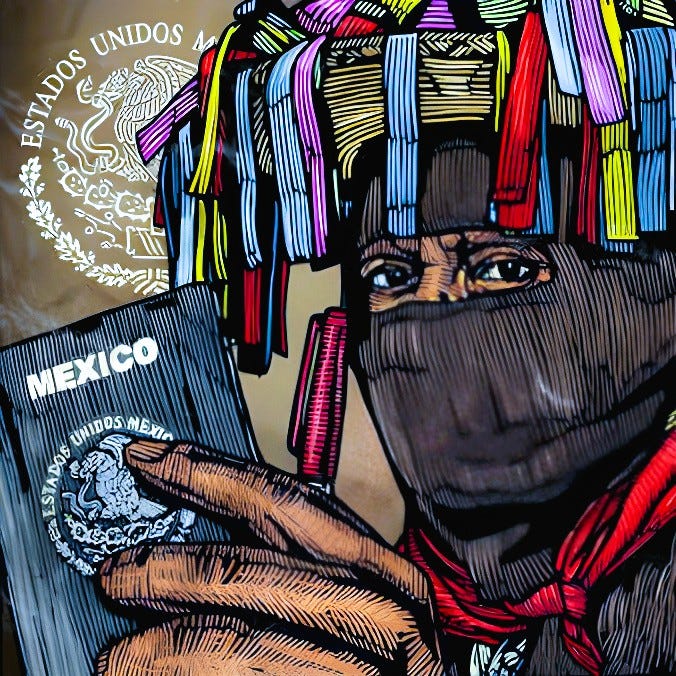
A snail is a house that moves slowly, but it is always a house.
The sacrifice of a snail is the sacrifice of its own body.
Snail. House. Path. Past. Present. Future.
They are the same thing.
They are in the same place.
A snail carries its house.
Modern development carries capital across land.
The people living on the land are expected to move.
The sacrifice of the caracol is not only the destruction of its house. It is the destruction of the body that makes the house a home.
“They are destroying the relationship between the people and the land, and once that relationship is destroyed, the land can be treated as an object,” the spokesperson said.
I was sweating profusely because I had just arrived at the meeting.
I had arrived late, or almost late. The room was already full. I found a place to sit and tried to cool down while photographs of communities in Mexico passed across the screen.
I had travelled to another town to attend the meeting. The National Indigenous Congress, or CNI, was travelling through the Spanish State as part of a solidarity tour before continuing into other states of the European Union. They had come to Europe carrying stories from communities scattered across Mexico.
I knew very little about what I was going to hear.
The CNI is a coalition of Indigenous peoples of Mexico, formed on 12 October 1996. The date was chosen deliberately. It was the day Spain celebrated what was once called the “Discovery of America”, the beginning of a history that would profoundly reshape the peoples and territories of the continent.
Eight years earlier, another date had already changed the political landscape of Mexico.
On 1 January 1994, the Zapatista Army of National Liberation, the EZLN, launched an armed uprising in Chiapas. Thousands of Indigenous insurgents seized several towns, including San Cristóbal de las Casas, and announced their existence to the world.
The uprising did not appear from nowhere.
The EZLN had been organising clandestinely in Chiapas since 1983. But 1994 was the moment the rebellion became impossible to ignore.
Much has been discussed, reported, written and analysed about the EZLN and its history in Mexico. We know the balaclavas, the poetry, the uprisings, the lives and deaths, the jungle, the project, the caracoles. We know the images that travelled around the world.
That is a story for another time.
This one is about the CNI.
The CNI emerged two years after the Zapatista uprising, bringing together Indigenous communities from across Mexico who were confronting different versions of the same question:
What happens when the people who live on a piece of land are no longer allowed to decide what happens to it?
The question sounds simple.
It isn’t.
Because land, as I was beginning to understand, was not being described as property.
It was being described as memory.
As identity.
As community.
As something closer to the body than to an object that can be bought, extracted from, developed, or abandoned.
And this was where the caracol began to make sense.
The snail carries its house because there is no separation between the two.
Perhaps a community can be understood in the same way.
Destroy the house, and you don’t simply remove a roof.
You begin to destroy the thing that made the house a home.
The conflict, according to the CNI, has escalated over Indigenous lands.
But listening to them, it became increasingly difficult to understand land as simply land.
They spoke about the spiritual relationship between people and the places they inhabit, and about how that relationship was being stripped away.
Land was not merely the centre of the conflict.
It was part of the identity of the people themselves.
There was an idea running underneath everything they said: the political struggle was embodied in the land, but also in the bodies of the people who lived upon it.
To remove people from the land was therefore not simply to relocate them.
It was to break something.
The CNI spoke of forced disappearances, political prisoners and communities living under what they described as a war situation.
They showed photographs, posters and postcards from the communities they represented.
Faces appeared on the screen.
Places appeared.
People who had been murdered, disappeared, imprisoned or displaced became more than numbers.
The message was difficult to misunderstand.
They believed there was a war against Indigenous communities in Mexico.
According to the CNI, the Mexican government, elements of the military and drug-trafficking organisations were involved in different ways, producing what they described as a situation of permanent violence with humanitarian and ecological consequences.
They gave figures.
Forty-five people had disappeared.
Two hundred and fourteen had been murdered.
One hundred and seven were being held in Mexican prisons, whom the CNI considered political prisoners.
They also spoke of connections between criminal organisations and the Mexican government, which they said had been demonstrated through different cases.
One of the people they mentioned was Jesús Plácido, an activist from a cell associated with the CNI. According to the CNI, he had been kidnapped by the Mexican army and was currently serving a prison sentence.
These were not presented as isolated incidents.
They were part of the same landscape.
A landscape in which the relationship between a community and its territory could be attacked from several directions at once: through violence, through criminal organisations, through government policy, through economic development, or simply through the gradual transformation of the land into something that could be bought, extracted, developed and sold.
Perhaps this was why the history of the CNI mattered.
The organisation emerged at a time when Indigenous communities were confronting the continued erosion of their languages, cultures and identities through the standardising power of the Mexican State.
Spanish had been imposed over Indigenous languages, and Indigenous people had historically been punished for speaking their own languages.
The CNI brought together what it describes as sixty-eight original peoples of Mexico.
Their demand was not simply recognition.
It was autonomy.
They wanted Indigenous communities to be able to decide for themselves what happened to their territories, their languages, their cultures and their futures.
In 2001, agreements that had been expected to produce political changes for Indigenous communities failed to materialise. The communities involved considered themselves betrayed.
The lesson they drew from this was not that the wrong person had been in power.
It was almost the opposite.
No matter who the ruler is, resistance will always arise.
The problem, in other words, was not simply the individual occupying the presidential palace.
It was the structure around him.
This was reflected in the way the CNI itself operated.
The organisation works with and within community assemblies. Agreements, deals and decisions are expected to be collectively discussed and collectively approved.
There is no single person who can simply decide on behalf of everyone else.
At one point, they had even considered launching a presidential campaign themselves.
The idea was not simply to win an election and replace one ruler with another.
Their strategy was supposed to be communicated to all the communities involved, decentralising power and ensuring that decisions could be taken through the agreement of the people themselves.
They were unable to make it happen.
Around that time, Andrés Manuel López Obrador entered government.
But for the CNI, the arrival of another president did not resolve the underlying problem.
The ruler had changed.
The struggle had not.
And perhaps this was where their idea of autonomy became more concrete.
Because the conflict was not only about political representation.
It was about who gets to decide what land is for.
The CNI is now celebrating thirty years of existence.
For this anniversary, they have been calling people to organise against what they describe as “zones of sacrifice.”
The phrase stayed with me.
A sacrifice zone is a place where people live, but where the people themselves become secondary to whatever the land can produce.
The territory is transformed into an industrial zone, an extraction zone, a mining project, an oil-producing area, or a mass tourism destination.
The inhabitants become an inconvenience.
The land has value.
The people living on it do not.
The CNI argues that European, American and Canadian companies are attempting to take control of territories across Mexico, particularly through mining projects.
They also spoke about plans by the Mexican State to develop strategic zones between the Gulf of Mexico and the Pacific coast, including industrial special zones and large-scale tourism projects along the coastline.
These projects may arrive carrying the language of development.
Infrastructure.
Investment.
Employment.
Public utility.
Modernisation.
But the CNI asks a simpler question.
Who benefits?
They showed examples of Indigenous resistance through a project called Resistance Mirrors, documenting communities that had opposed these projects and, in some cases, managed to stop them.
Resistance, therefore, was not presented merely as an act of desperation.
Sometimes it worked.
Sometimes the project did not happen.
Sometimes a community managed to say no.
One of the communities represented during the European tour was the Chontal people. The main representative travelling with the delegation came from this community and had been elected as a spokesperson by the CNI.
His presence gave the tour a particular weight.
These were not people travelling around Europe to explain an abstract political theory.
They were carrying the experiences of communities.
They were carrying their photographs, their demands, their dead, their imprisoned and disappeared, their territories.
And they were carrying the question of what happens when somebody else decides that the place where you live would be more profitable if you were no longer there.
They gave another example from Oaxaca.
There is an oil refinery there that, according to the CNI, has produced serious pollution in the surrounding area.
The contradiction they described was almost absurd.
Companies can profit from the extraction of resources, while the communities living nearby can still lose something as basic as electricity when it rains.
The resource leaves.
The profit leaves.
The consequences remain.
Again, the phrase returned:
“Sacrifice zones.”
Who benefits from the extraction?
And who pays for it?
The CNI’s answer to this problem is partly contained in the way these communities understand ownership itself.
They spoke about the idea of social property, which they said represents around 51 percent of Indigenous land.
Land is not understood simply as an individual possession.
Its administration is based on communal rules and collective responsibility.
Those who work the land are also responsible for it.
Decisions concerning it must be discussed in an assembly.
The community decides.
This system of collective organisation has allowed some communities to resist and dismantle foreign and national investment projects.
The land cannot simply be sold by one person because the land does not belong to one person.
It belongs to a community.
Or perhaps it is more accurate to say that the community belongs to the land as much as the land belongs to the community.
The same struggle appears in places where the threat does not arrive in the form of a foreign mining company.
The CNI spoke about the avocado industry and the way drug-trafficking organisations have seized control of parts of the market.
Farmers can be forced from their land through criminal violence.
The cartel does not necessarily need to own the territory in the conventional sense.
It only needs to make remaining there impossible.
The communities resist these practices too, confronting what the CNI described as Mafia-like structures operating around agriculture and local economies.
Again, the question is not simply who owns the land.
It is who can remain on it.
Who can work it.
Who can make decisions about it.
Who benefits from it.
And who is expected to disappear when somebody more powerful decides that the land should be used for something else.
The CNI also spoke about constitutional reform.
They wanted to reform Article 2 of the Mexican Constitution, which stipulates that the Mexican nation is multicultural in composition and recognises the rights of Indigenous and Afro-Mexican peoples and communities to self-determination and autonomy.
But they were deeply sceptical about the government’s proposed process.
The government, they said, wanted to consult approximately three thousand Indigenous communities in thirty days.
To the CNI, this was not a serious attempt to resolve either the historical problems or the new problems confronting Indigenous communities.
Thirty days to listen to thousands of communities.
Thirty days to understand territories, languages, histories, conflicts and demands.
Thirty days to decide what should happen to people whose relationship with their land may have existed for centuries.
It seemed almost designed to produce an answer before anyone had properly heard the question.
And beneath all of this was the constitution itself.
The constitution establishes the limits of sovereignty.
But between the written limits of sovereignty and the reality of political power, the CNI sees rampant corruption.
Public utility, they argued, repeatedly ends up benefiting the state, contractors and those who subsidise or finance the projects rather than the communities whose lives are directly affected by them.
The road is built.
The mine opens.
The refinery operates.
The tourist complex arrives.
The electricity network is expanded.
The investment is celebrated.
And somewhere beneath all of this, the people who already lived there are asked to adjust.
Or leave.
Or disappear.
Yet the CNI did not speak as if resistance were something that belonged only to the past.
They spoke about it as something that would continue.
No matter who rules.
No matter which party occupies government.
No matter which company arrives.
No matter how much money is offered.
The resistance remains.
The CNI will keep resisting.
It was getting late.
I had to leave for the station.
It was my last train.
I said goodbye hurriedly and began walking.
By the time I was sitting inside the train, I felt a strange kind of lethargy. The day had been unbearably hot. I rested my head against the window and watched the territory pass by.
And then I began to see what the CNI representatives had been talking about.
Industrial structures.
Massive farms.
Wind turbines.
Solar panels covering stretches of land.
Logistics platforms.
Data centres and the infrastructure of foreign companies.
This was what they had noticed while travelling through the territory. They had been speaking with people along the way, listening to what they had seen and what had happened to their communities.
They also knew that this land had once spoken another language.
Of course, the differences between an Indigenous community in Mexico and a territory in Europe are enormous.
The distances between the two oceans are not merely geographical.
Comparisons can be unfair.
But I found myself thinking about what they had seen before arriving here.
And what they had thought about it.
I wondered whether their situation was not, in some deeper sense, a version of something that happens everywhere.
Not the same story.
Not the same violence.
Not the same history.
But perhaps the same root.
Like one deep root beneath an enormous tree, branching into places that appear completely unrelated.
Capital adapts to change faster than communities do.
That much seemed obvious.
Capital can move.
It can cross borders, change industries, abandon one territory and enter another.
Communities cannot move so easily.
They carry their dead.
Their languages.
Their memories.
Their houses.
Their fields.
Their cemeteries.
Their stories.
But then another question came to me as the train moved through the darkening landscape.
What happens to the land?
I thought of another caracol from the other side of the Pyrenees.
In the Landes, in southwestern France, there is an old Gascon legend about Lou Carcolh, a gigantic snail-like creature said to live beneath the hill of Hastingues. Its shell was said to be as deep as a house. Those who ventured too close could be dragged inside by its tentacles.
I liked the idea that somewhere beyond the border, the snail had become a monster.
Perhaps every house becomes frightening when someone tries to take it away.
And I thought of that saying: “Snail, with your little house on your back, you don’t pay rent.”
A great cloud opened beneath the last rays of the summer sun, flooding the buildings under construction on the outskirts of the city with light.
The cloud took the shape of a caracol.
I stayed there watching the light until night fell.