

I don’t like nations. I like survivors. I like betting on losing dogs.
Eskorbuto were playing in my headphones as the bus entered Madrid, the capital of the Spanish State. They were singing it forty years ago:
Este maldito país es una gran pocilga.
This damned country is a great pigsty.
Maldito país. España.
Damned country. Spain.
Outside the window, new apartment buildings were rising everywhere. Concrete, glass, balconies stacked one above another, cranes suspended over the city. More homes appearing in a city that already seemed to have too many people and not enough places for them to live. I watched them go by and wondered: why would anyone want to live here?
It was not really a question about Madrid. I knew why people came and why people kept being born here. Work. Money. Universities. Love. Ambition. The usual reasons we give for moving towards a city. I meant something else. Why would anyone want to build their life inside this? Another tower. Another development. Another collection of apartments waiting to become somebody’s investment, somebody’s rent, somebody’s mortgage.
Maldito país. España.
The bus kept moving. I was entering the capital of the country whose passport I carried, listening to a Basque punk band calling Spain a pigsty, and for once the contradiction didn’t seem particularly contradictory.
I probably would never have come to Madrid on my own. Not because I had anything against the city. I simply knew it mostly as a place to leave Spain from, through Adolfo Suárez Madrid–Barajas Airport. This time, I had a reason to stay.
A Mexican friend was there.
Perhaps that was why Madrid already felt foreign.
It has always been foreign to me.
For a long time, I think my identity was somewhere in the Pyrenees. Not in Spain. Not particularly in Aragón, either.
My father took me there when I was a child. I grew up with the mountains, the green valleys, the rain, the snow covering the roads in winter. The Pyrenees never felt like a border to me. They were simply there. Basque, Aragonese, Occitan, Catalan — different languages, different histories, different peoples, divided between two states. But the mountains did not seem to care.
I crossed the French border without feeling that I had really left the landscape behind. I remember the chocolate factory at Oloron-Sainte-Marie, berets and bagpipes, old Aragonese names written on signs and spoken by people whose voices seemed to carry something older than the states that governed them. This was the geography I knew before I knew what nationalism was.
Perhaps that is why I have never understood the need to choose a flag.
I have nostalgia for the Pyrenees. But I don’t think I belong to them. There is a difference. The places that made me who I was never asked me to belong to them.
But time takes things without announcing itself. The names disappear. The factories change. The people grow old. The snow comes later, or not at all. And eventually you return and realise that the landscape you thought had been waiting for you has been moving on without you.
Perhaps that is what I have been mourning all these years.
Not a country.
A landscape.
And the person who existed inside it.
A few days earlier, I had gone to the administration to submit a poetry book in Aragonese for a literary competition. The first thing they asked me was whether it was written in “fabla”, a dismissive word often used for the Aragonese language. Then they asked why I didn’t have an electronic national ID card.
I told the woman that I had left Spain a long time ago. She explained that I could get one and use it to access the website. I told her it didn’t really matter. I was leaving the country anyway. I just wanted to submit my book.
She didn’t seem to like that.
There was something almost absurd about the exchange. I had walked into an Aragonese office carrying a book written in a language from the place I came from, and somehow the more important question was whether I possessed the right piece of plastic proving that I belonged to the Spanish state.
I have always had a weakness for losers.
Negu Gorriak singing Gaberako aterbea in Basque. Nadau playing at the Olympia in Paris, singing about the search for the immortal flower that grows only in the valleys. Kneecap making a film about working-class lads in Belfast, switching between Irish and English as naturally as the city itself. A Welsh film about a poet who died in Flanders, unable to write to his family in the language he loved. Zapatista communities in Mexico moving between Spanish and Indigenous languages. The Ainu in northern Japan, carrying a language that was once pushed towards silence. And somewhere in Australia, a language with a grammar so elaborate it had dozens of cases, spoken by only a handful of people.
Different languages. Different histories. Different ways of being pushed to the edge.
Perhaps that is why I wrote the book in Aragonese. Not because I wanted another flag. Because I wanted to participate in something that had survived long enough for me to find it.
I have always bet on losing dogs. Not because I expect them to win, but because I like seeing them still running.
I have carried pieces of places with me. In France, I encountered Occitan in everyday life. At the school where I worked as an assistant, some of the children were euskaldunak. I would greet them in Euskera, even though French was the language I was supposed to speak with them. Not because I wanted to become Basque or Occitan or anything else. I simply liked the idea that a place could leave something behind in you.
Perhaps that is what culture means to me. Not something you inherit and then defend with a flag, but something you encounter and decide to carry.
I would have written the poetry collection in Navajo if I had been given the chance. I don’t need a culture to tell me who I am before I allow myself to love it.
That is different from nationalism.
Nationalism asks:
Who are you?
And then gives you the answer.
I have always preferred another question:
What moved you?
And then I carry it with me.
On the way home, I lost my Spanish DNI.
For three days, I didn’t care.
A friend eventually found it inside a bar and gave it back to me. I felt no particular relief. Only gratitude that I wouldn’t have to explain its disappearance to the police.
It surprised me how little I cared about losing a document so closely tied to identity. Being regarded as Spanish has never mattered that much to me. What matters are the things that come with it: the freedom to move, to live and work elsewhere in Europe, to cross borders without thinking about them.
I am as grateful for those things as I feel angry knowing that this right is refused to others.
But that is not the same as loving the country.
I have never particularly liked Spain.
I like the people underneath the state. The people I have actually met. The people I have shared meals with, worked with, argued with, loved, or simply passed on the street.
But how am I supposed to feel attached to a country made up of millions of people I will never know? You don’t know everyone from your country. You don’t even know everyone from your region. You don’t know everyone in your city.
At some point, nationalism asks you to make a leap.
These are your people.
Why?
Because they happen to have the same passport.
I have never understood that leap.
I care about people I know. I care about places I have seen. I care about languages I have heard and decided to carry with me. The state can tell me what I am on paper. It cannot tell me what moved me.
And I don’t want another identity to replace the one I am rejecting. I don’t want a Spanish identity, an Aragonese identity, a Basque identity, a Catalan identity, or any other identity imposed from above to swallow the small things I actually love about places.
I would defend their languages. Their histories. Their particularities. The small and stubborn things that make a place itself.
But I become suspicious when those things are handed over to administrations.
Administrations know how to turn culture into capital. A language becomes a campaign. A tradition becomes a tourism slogan. A flag becomes a photograph. An identity becomes a constituency.
What was once lived becomes something that can be managed, branded and sold back to the people who produced it.
Perhaps this is why nationalism has never felt like home to me. It asks me to lose myself inside something larger and more permanent.
The nation.
The region.
The people.
The flag.
I have always been more interested in smaller things: a street I remember, a language someone speaks to their grandmother, a cemetery beside my parents’ house, a bus that doesn’t come, a place where rats still know how to survive.
Those things do not need to tell me who I am.
They simply remind me where I have been.
I enjoyed my time in Madrid. Six hours around Retiro Park, Lavapiés and Atocha with my friend S. were more than enough.
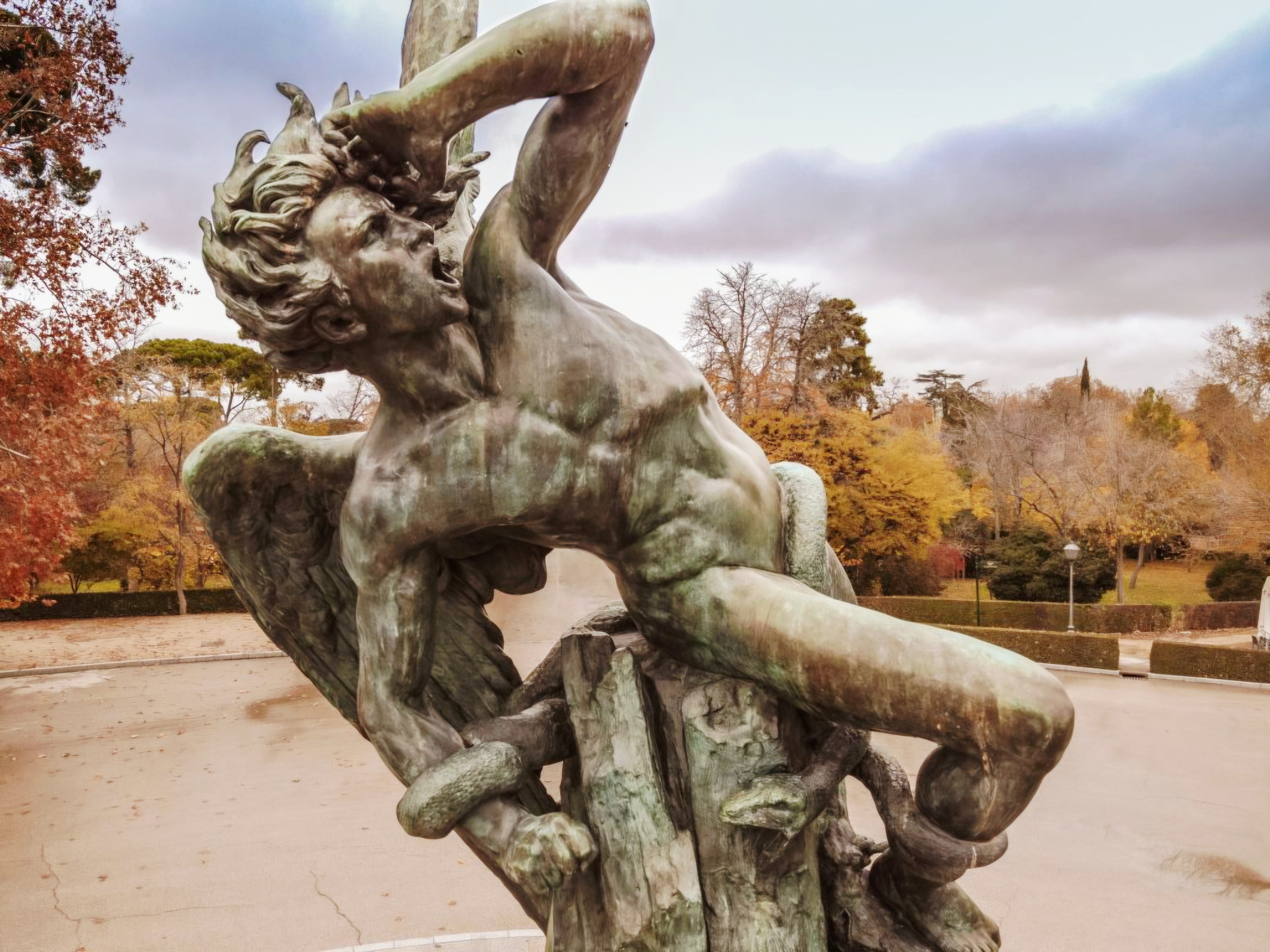
We hadn’t seen each other in years. I enjoyed his presence. We walked through the park and watched the Fallen Angel statue slowly disappear into the midday heat.
The city itself didn’t interest me that much. But I was glad I had come.
Perhaps that was enough.
A place does not have to become yours for the people you meet there to matter.
After lunch, S. accompanied me to the bus station.
I headed north.
Madrid disappeared.
The sunset was hitting the Sierra de Madrid as the bus left the city behind. I put on Zootopia and one of Eskorbuto’s albums.
There was something strange about watching a children’s film while listening to a band that had spent forty years telling Spain to fuck off.
The mountains appeared in the distance.
Then Zaragoza.
Aragón.
It was late when I arrived.
The first thing I saw was the giant Spanish flag projected on the bridge. I knew that bridge. Years ago, I had seen it in a video for an anti-racist rap song. The same city. The same concrete. The same river underneath it.
Now the flag projected above it was enormous.
I stood there looking at it and thought about the people in Ceuta.
Some weeks ago, thousands of migrants had arrived in the city after crossing from Morocco. The language around them had quickly become the language of invasion. People marched under Spanish flags and demanded that the border be defended.
The Spanish Popular Party had won the election in my region.
An election I hadn’t wanted, and hadn’t voted in.
I had been away.
Still, somehow, the result belonged to me.
I had spent the day walking through Madrid with a Mexican friend I hadn’t seen in years. I had spent the previous weeks thinking about languages that had survived borders and states. I have spent so many years away.
And now, arriving home, I was standing beneath a flag telling me who belonged here.
There were not enough buses.
I had to wait.
By the time I finally made it back to my neighbourhood, it was quiet. The streets smelled of rubbish. There were rats. They moved between the buildings as if they had always been there.
Perhaps they had.
Rats don’t care about flags. They don’t care which country the street belongs to, or which language is written on the signs. They know when a ship is sinking. They leave before everyone else.
Sometimes the rats survive while the good men die.
Sometimes the rats get rich.
Perhaps that is what survival looks like when nobody is keeping score.
The neighbourhood had been decaying for years. The old buildings were tired. The places that once gave the area a purpose had disappeared. And underneath it all was another history.
This had once been a concentration camp.
My grandfather had been there.
And, apparently, so had the grandparents of the rats now running through the neighbourhood.
So, in a way, we were almost family.
The city had changed. The people had changed. The buildings had changed.
The rats remained.
I watched them disappear into the darkness and thought about losing dogs. About languages that refused to disappear. About the Pyrenees, where the mountains had never cared which country they were supposed to belong to. About the flag above the river. About the card in my pocket that said I was Spanish.
The rats didn’t care about any of it.
Perhaps that was why I understood them.
I fell asleep.