

On a slow autumn afternoon on the shores of the Roskilde Fjord, I was trying to escape my life for a few brief hours, even though I knew I would have to return to it before long. I immersed myself in the pale, cool colours of the Danish autumn sunset, leaving behind - if only for an afternoon - the university, my flat, my partner, and my life.
I often walked to Sankt Hans when the distant sound of buses had faded away. It was quieter then. I wandered along its paths beneath a canopy of crackling leaves in shades of red, yellow, and brown.
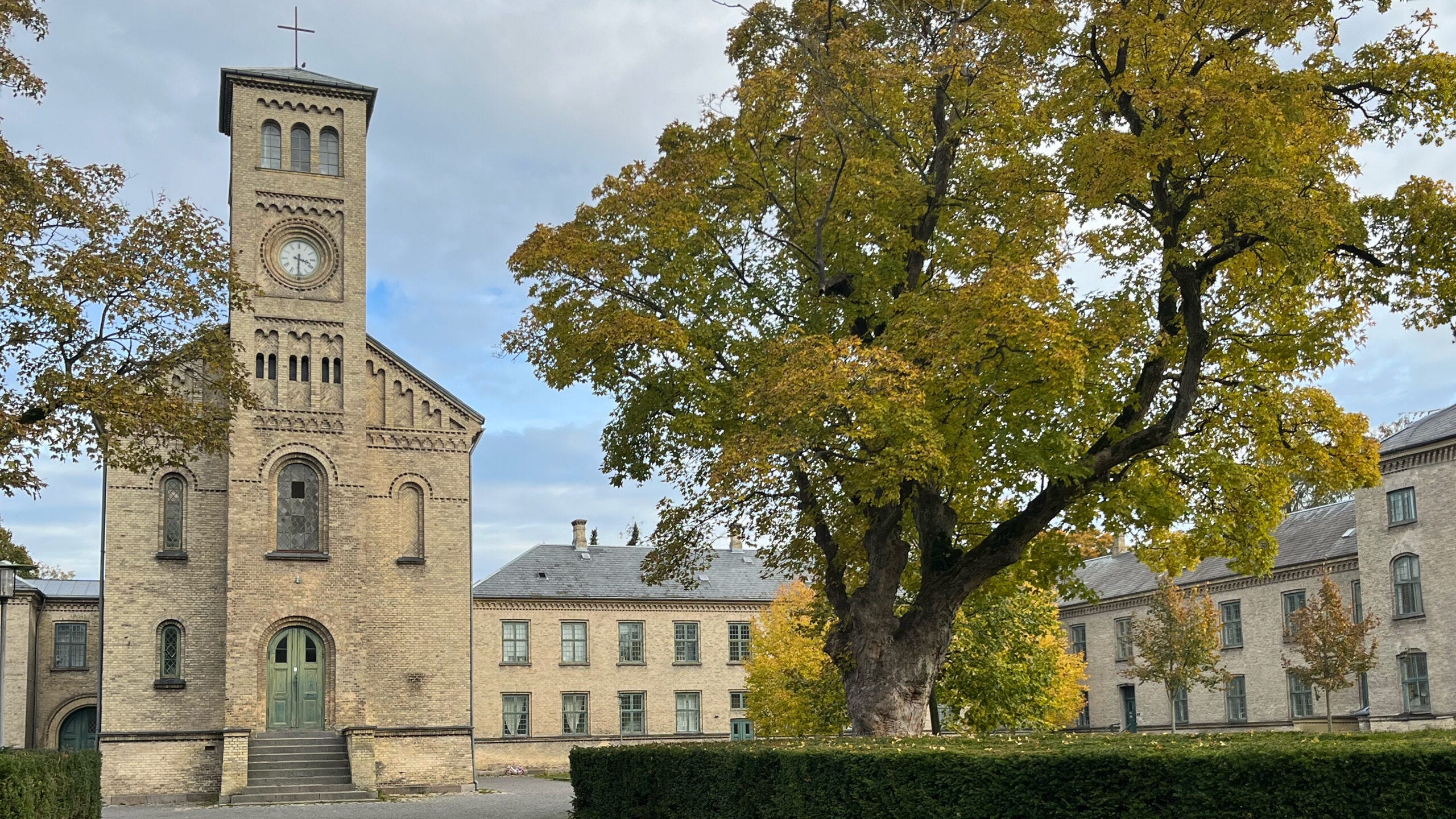
St. Hans is one of the largest psychiatric hospitals on the Danish island of Sjælland. Like any psychiatric hospital, the clean, pragmatic lines of its buildings unsettled me. Behind the windows, nothing could be seen - only the fading reflection of the last boats crossing the fjord towards the harbour, the steady hum of the ferry, and, in the distance, the bells of Roskilde Cathedral.
By 2023, after returning to Europe, I had walked those paths countless times.
The hospital stood among open fields and bare trees, their roots reaching towards the water’s edge, while birds skimmed low over the fjord.
There it was.
Between the sunset and the water.
Between the silence and the wind.
For a fleeting moment, with the cold Danish autumn pressing against my face, the whole kingdom of Denmark felt as though it belonged to me.
Suddenly, footsteps broke the silence of the fjord.
As I turned my gaze, I saw small figures moving through the last wisps of mist rising from the lingering rain and the orange-ochre glow of the sunset. Light footsteps crackled among the roots and branches of the forest. In the blink of an eye, they had vanished. Only faint echoes lingered in the distance, somewhere within the safety of the hospital wards.
The sound stirred a strange curiosity in me. At eight o’clock on an autumn evening in Denmark, I found myself walking towards Sankt Hans Hospital.
The door to the little chapel creaked open; someone must have forgotten to close it that afternoon. I used to spend long afternoons reading in its tower, surrounded by cobwebs and ancient machinery, fixing my gaze - my whole body, almost - on the metal shafts that supported the great bell that had never rung.
The clock, worn down by time, stared back with a bitter grimace as I looked through the windows, where a light rain had begun to fall in scattered patches. I leaned against the glass and listened once more to the footsteps moving along the hospital’s cobbled paths.
Determined to find whoever was out there, I went downstairs and crossed the chapel. There, on the neat, damp wooden benches, lay a single book: a collection of poems in Danish. I opened it at random and found a poem entitled Krystalslottet. I paused to read while the sounds scraped softly against the windows.
The poem spoke of a fragile castle standing alone on the shores of a lake.
Outside, the voices grew louder.
A sharp, almost electric sound.
I descended the final steps and stepped into the church square.
There they were.
Behind the trees, motionless, murmuring.
Small figures.
Children.
Children clutching walkie-talkies and plastic rifles, running and leaping across the damp carpet of leaves that covered the stone courtyard of Sankt Hans Hospital. They shouted to each other in a language I could not decipher, throwing themselves behind walls and tree trunks, turning the hospital into a maze of trenches and the fjord into an invisible front line. They disappeared into the woods whenever the rain grew heavier, only to emerge again a few moments later.
I watched the scene in silence.
It was late.
I had to go home.
Then two women appeared through the rain and the mist. They walked calmly towards the children, sheltering them beneath enormous umbrellas before gently leading them towards a yellow stone building, its wooden window frames covered with green moss. A single light glowed behind the windows.
The door closed softly.
As I turned the corner towards the bus stop, it was time to go home. As the bus wound its way around the bay, the crystal castle remained in the distance. Nestled among ancient, weathered leaves, St. Hans Hospital resembled the castle from the poem, fragile, isolated, almost unreal.
The gardens and triangular houses, with their perfect lines, marked the way back to my flat in Trekroner. By the time I arrived, night had settled over the concrete outlines of the university, and a single light glowed in the distance, probably the Argos power station. I found myself thinking of the yellow light at St. Hans Hospital.
That night, sleep came quickly. In my dreams, the crystal castle glowed in the distance against the darkness.
The following morning, over coffee, I told one of my classmates about the previous evening - the hospital, the rain, the children.
“Ah,” he said, almost casually. “Of course. They’re Ukrainians.”
“Ukrainians?”
“I thought most of them had gone to Poland or Germany.”
“Many did,” he replied. “But some came here, to Denmark. They’re staying at Sankt Hans.”
“Since when?”
“You weren’t here then. I think they arrived after Russia invaded Ukraine.”
“They’ve been living in the psychiatric hospital all this time?”
He nodded.
“I saw them playing war,” I said.
He was silent for a moment.
“I suppose that’s the only thing they’ve known in recent years.”
My alarm rang. It was time to go back to class.
Outside, rain drifted almost horizontally across the campus, carried by the wind. I thought of the children of St. Hans and wondered whether those same clouds, skimming the damp grass before lifting again towards the edge of the island might one day carry them home.