

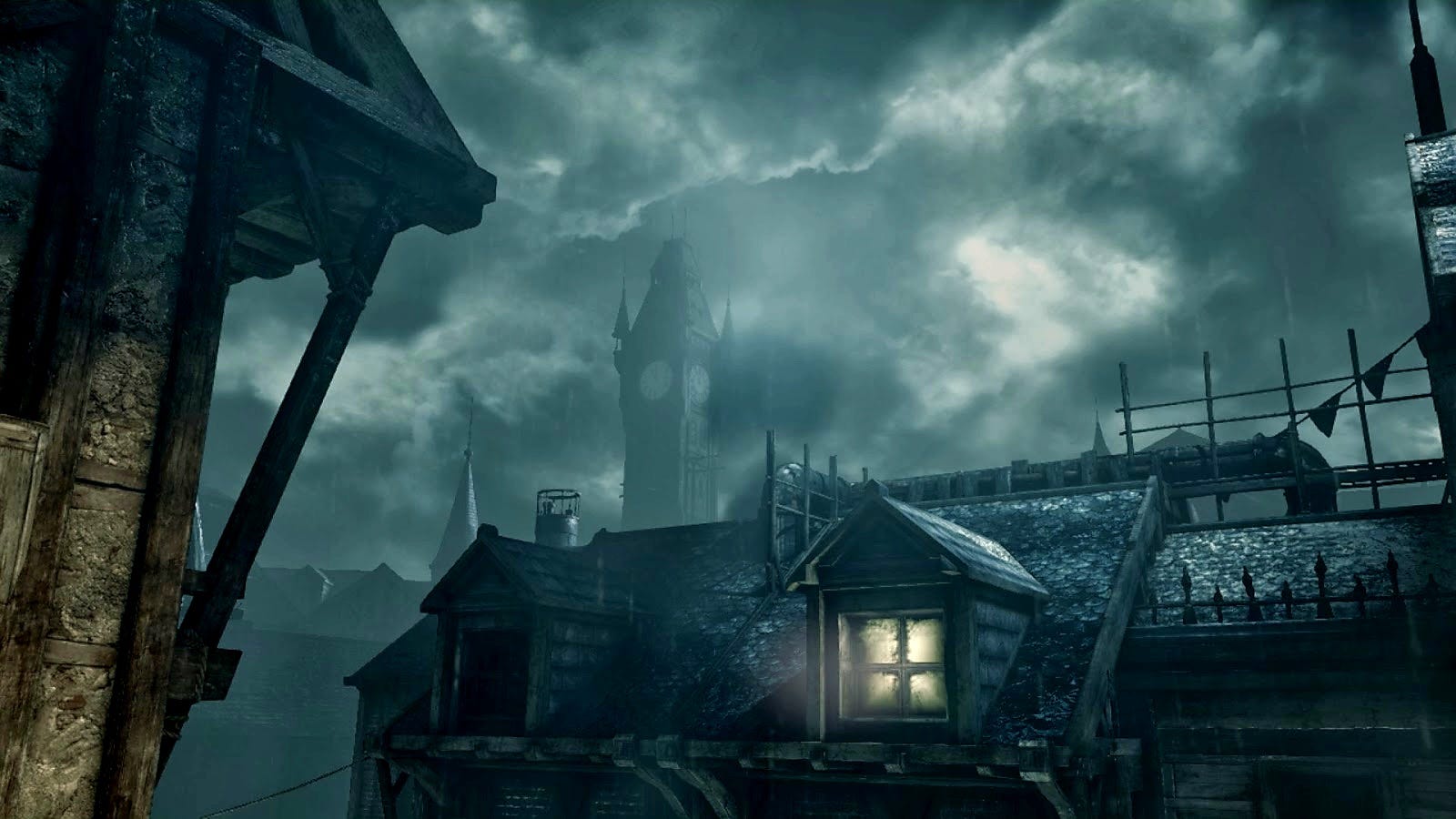
I have never been to The City. Yet I know its streets better than I know some places where I have actually lived. And I have sometimes wondered whether you can feel nostalgia for somewhere that never existed.
I would call it Phantalgia — from the phantom of fantasy and nostalgia.
I remember the first time I entered it. It was raining. The streets were almost empty, and the light from the windows fell onto the wet stones. The Clock Tower rises above the fog enveloping the city, and beneath my footsteps the murmur of its mechanical entrails slowly rises through the cornices and faint shutters. Only the tinkling of gas lamps breaks the darkness and silence.
I can hear every word spoken by the citizens behind the city’s ancient, massive walls. The rain intensifies the sound of the factory gears, and as it strikes the wet, dark pavements, it joins the bells of the Clock Tower. It is midnight now, the wolf hour.
In the distance, the sounds of the Docks move towards the Stonemarket, and I follow them. Hidden in the shadows, because in the city darkness is my room, and my room is darkness.
The way home is harder than ever, despite knowing every turn and every door that must be passed through. I move wrapped in darkness and rain, avoiding every encounter until I reach the Clock Tower, a refuge for day and night.
Then I lie down in bed and extinguish the candles.
The city twists and I carry my eyes inside it. And slowly, the lines between us become confused.
Device battery: 10%.
The truth is that the City does not exist, and I don’t remember the City so much as I remember myself inside it.
I know this because I have spent countless hours walking through it from one room to another, from one apartment to another, from one country to another, always through my laptop screen.
The City is the setting of a videogame called Thief.
I have returned to this videogame for more than a decade, from rooms in Paris, Copenhagen, Tokyo, Cape Town, and elsewhere.
A videogame where a shadow becomes a room.
The beautiful thing about The City is that I could leave it for three years and return to find that it had been waiting for me.
I wonder if nostalgia requires reality.
I left home once to become a stranger elsewhere, and eventually came back to discover that I had become a stranger at home too. But The City was different. Inside it, I had remained remarkably unchanged. Perhaps I was an avatar. Perhaps simply another character moving through a world that had somehow preserved me.
Real cities don’t do this. You leave an apartment and someone else eventually lives there. A café closes. A street is renovated. A building disappears. A landscape changes slowly enough that you only notice when you return.
The City doesn’t.
Its Clock Tower still rises above the streets. The same windows glow at night. The same alleys remain hidden beneath the same rain. It was never quite like the places I had lived, although its Clock Tower always reminded me of the one at Copenhagen City Hall. The City felt less like a historical place than someone’s memory of history — distorted, fragmented, half-remembered.
Perhaps that is why I could return.
You can leave a videogame for years and come back to find that nothing has moved.
A videogame can become a private geography of your life.
I know this because I have carried The City with me for more than a decade. I have walked through it from rooms in different countries, through the small illuminated rectangle of my laptop screen. Sometimes I was in Paris. Sometimes Copenhagen. Sometimes Tokyo. Sometimes Cape Town. The City remained the same while everything around me changed.
The last time I played, I was going through a breakup.
There was one mission I remember with particular discomfort. Garrett has to spy on people in the privacy of their bedroom, watching something intimate from the darkness. I had just ended a relationship, and the voyeurism of the scene made me strangely miserable. I remember thinking that I didn’t want to be looking at somebody else’s intimacy.
I wanted the person who wasn’t there anymore.
For a moment, the fiction became more uncomfortable than reality. I wanted to leave the game, but I couldn’t if I wanted to continue its story. And yet I kept playing.
Because perhaps I wasn’t playing to complete the mission.
I wasn’t playing to achieve anything.
I just wanted to exist somewhere else for an hour.
And there was Erin.
Erin, the girl who disappears and sets much of the story in motion. I found myself worrying about her in a way that was difficult to separate entirely from the life I was living outside the screen.
Erin reminded me of someone I had once wanted to protect from the shadows of a city, too. The fracture between Garrett and Erin stirred echoes of my own breakup. Their relationship became entangled, somewhere in my mind, with something I had just lost.
It sounds strange to say that I worried about a fictional character.
But perhaps that is precisely what fiction does. It gives our feelings somewhere else to live.
The City itself stretches from the gargoyle-studded mansions of Auldale to the stony expanses of the Old Quarter. Every city is a reflection of the spirit of its time, but The City feels as though every one of its roots belongs to an ancient and colossal tree beneath the ground, its branches reaching into every life within it.
It is dark, narrow, dangerous and lethal.
And yet I don’t think I have ever found a better place to belong.
There is a strange comfort in that paradox. I sink into the silence announced by the zinc rooftops, into the voices drifting through the alleyways, into the rain falling somewhere beyond the walls.
Perhaps The City is a mirror.
Not of the person we actually are, but of the person we are forced to become when nobody is looking. A vulnerable and strangely honest reflection of ourselves.
And perhaps that is why I kept returning.
I don’t miss Erin.
At least, I don’t think I do.
I miss the person I was when I was worried about Erin.
The person sitting alone in a room somewhere in the world, watching rain fall over a city that had never existed.
Perhaps I don’t miss The City either.
Perhaps I miss myself inside it.