

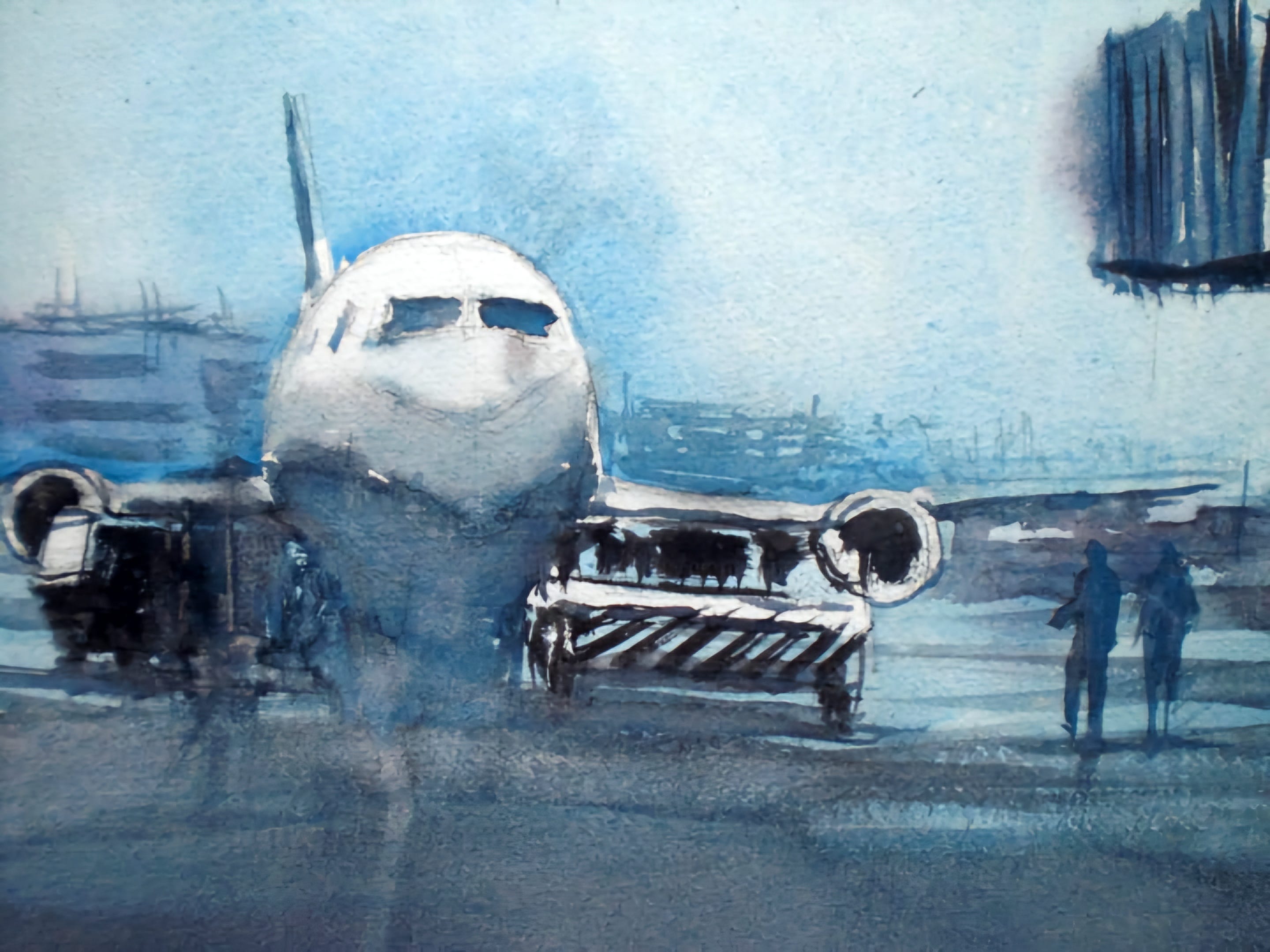
They say the sky and the earth are grey, but there is the horizon.
At Addis Ababa Bole International Airport, rain falls against the cracked glass of my retina. As it strikes my gaze, it slowly and sacredly runs down the windows and the fuselages of Ethiopian Airlines planes. It gathers, methodically, the words spilling into my little notebook, and I write down the date: an ordinary day in October.
It is a line dividing two destinations: one in the past, the other in the future. A few hours ago, I was melting on the asphalt of Johannesburg; in a few more, I will be broken and cold beneath European skies, on my way to France. None of it matters very much: the Great African Rift, the impossible tropics, the Sahara, the Mediterranean, the airport lights. Much later, I too will languish in the fumes of Chunghwa cigarettes, watching Chinese businessmen pass through the scene. I will melt beneath the bright spotlights marking the airport’s synagogue and mosque, and among the elephants made of crumpled cotton on the shelves of the souvenir stands.
I can be all of that, and also just another passenger at Addis Ababa Bole International Airport, Ethiopia.
And the layovers will matter a little less. In this state of transit, I too want to become part of Ethiopian history.
The same history I had so often looked in the eyes of at the Musée du quai Branly in Paris, back when I still lived there. When I was writing my thesis, Ethiopia reached me only through the warm glow of my computer screen, as night settled over a Danish fjord. Ethiopia had many capitals, as many as the footprints unfurling along the roads of the ancient Kingdom of Aksum.
It is something akin to everything that has existed, and everything that will continue to exist long after us. The Ethiopian flight attendant crossing herself before take-off, pilgrimages to Mecca, the smell of excavators throbbing on the outskirts of the capital, the dark outlines of Harar’s alleyways, the swarm of ants in Tigray…
But what is it that makes a city a city? In 1929, the Soviet economist S. A. Besenov wanted to make the city and its industry part of the identity of the workers associated with them, since they had lost their sense of belonging to their districts.
The city matters less than its boundaries. African borders are (often) geometric and perfect, and between them lie mountains, cities, deserts, ethnic groups, jungles… Meanwhile, the royal caravans that once travelled through the lands of Ethiopia, shifting the balance of power as they went, are difficult to comprehend for the feudal lord in his European castle, or for the functionaries of Middle-earth trapped in the bowels of the Forbidden City.
Centuries later, after Mussolini and the Derg, Ethiopia remains nomadic or at least it does in this airport. Addis Ababa will wake tomorrow as it went to sleep yesterday, carrying the memory of a past.
And like a cat, I can fall anywhere, only to ask myself afterwards: why am I a cat?
And I will remember that story my father wrote, and I too will say: “Good hunting, Bastian,” and I will remember everything for a second when I see a leopard on the shelf of the souvenir shop.
Me too. Inevitably, like a courtier in an Ethiopian royal court, I will finish my cigarette, tucked away between the fabrics of Chinese construction executives’ suits and the Algerian stickers in the smoking room at Addis Ababa Airport.
Then I will receive a message on my phone announcing my flight’s departure.
I will leave, forever, if time allows.