

Never before had I returned home so soon. Perhaps because I had always tried to leave only shallow footprints, the kind that do not crush butterflies.
Summer was fading through the fractured corners of the river. The water carried away every sound until the voices and the echoes of the animals were erased. The wind struck the trees with the wrong shade of green; it should not have been summer. The reflection of the riverbanks stretched horizontally towards a sky that felt clean and certain.
Then I saw myself.
There, among the ochre colours of the trees, was my own reflection. Trapped between the stone and the sky, a dead and mutilated body. The river flowed on while I remained there, broken among its rapids, my skin scraped by the jagged rocks and my eyes bruised by the passing minutes. I was the quiet outline of a body that had already come to an end.
For not everything that dies leaves an empty space behind.
I was every damp footprint upon the convulsing branches of uninhabited days. I was all the silence drifting through the blue currents of summer.
The wind lifted its arms.
Never before had I returned home so soon.
To return, even when there is nothing left to return to. It is almost as impossible as describing my own body reflected in the river. Almost as impossible as the ivy that wraps itself around the exhausted walls of the village.
That is how I found myself, a decade later, standing before the final breaths of a life that had ended long before I was born. During a summer holiday back home in northern Spain.
This story has a name which, simply because it is so rarely spoken, almost seems not to exist:
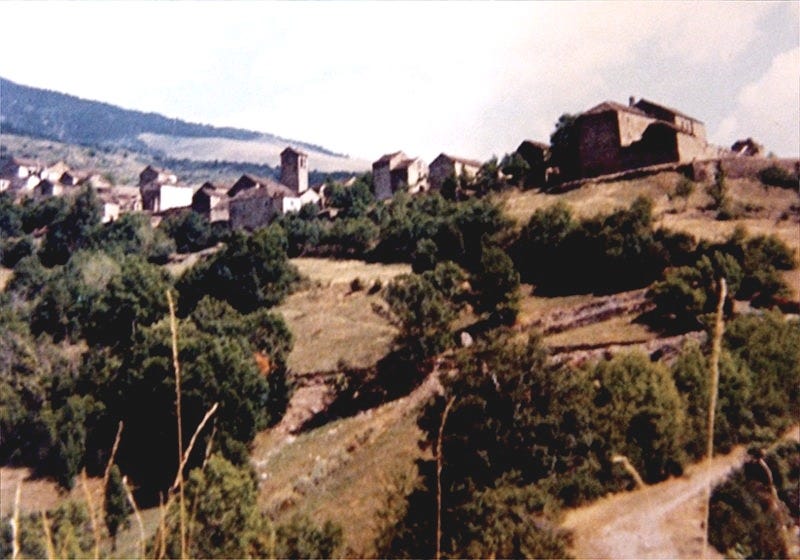
Zenarbe - an abandoned village in the Aragonese Pyrenees.
To return, as I have returned for the summer; to return in order to see what others once left behind, just as one day I too will leave things behind that I shall never see again.
Something hidden inside a rain-worn stone.
The first time my heart was broken.
There, almost at dusk, wrapped in a storm of red and leaden leaves, hidden within the walls of the church - the letter I left behind.
Like many villages in the Aragonese Highlands, Zenarbe fell victim to the government’s programme of forced depopulation linked to the construction of a reservoir. Officially, the village ceased to exist on 21 November 1966.
Most of its inhabitants left for the industrial cities of Spain and France. The village itself remained behind, waiting only for its new inhabitants: snow, ivy, and the slow work of decay.
Years later, during the 1980s, much of Zenarbe was deliberately demolished with explosives. Officially, the buildings were considered dangerous and were destroyed to prevent accidents. For many former residents, however, the demolitions carried a deeper meaning. In Aragon, the house is more than a building; it is the centre of family memory and belonging. Once the houses disappeared, so too did the possibility of returning to them.
Slowly, almost methodically, Zenarbe was reduced to its roots. Today, only fragments remain: the narrow cobbled street, the cemetery beneath the cypress trees, and the church tower, still standing, watching time quietly slip away.
Weathered like an old oak, the church still watches over the valley, its tower rising above the fields while the years themselves seem to disappear into the distance.
So do I.
The letter was written a long time ago.
When I reach the village, I search for it among the stones. I twist and sink my hands into the rock, as if trying to rescue the words I abandoned there years ago.
The afternoon approaches, impregnating the contours of the mountains with its demented howl, and the letter.
The letter is not there. Only I am.
Perhaps it was beyond the door scratched by winter; perhaps the rain has already destroyed the sad, pale, and scarce fabric of my words, and most probably, nobody will ever read the letter.
The orange sun of the afternoon strikes the valley, the dead reflection of the river, the cemetery of Zenarbe, my swaying body, and the wild memory - everything I once was, everything I will be.
Every memory of myself throws itself against the years, and it is because I have grown, not horizontally, but along a thin and narrow line, yellowish and sickly at times, of fire and memory always, almost like the act of falling.
Afterwards, on the road, I will ask myself: why do we always fall?
Zenarbe is something that rises, softly levitating above the roots to reach the sad and leaden sky, in any of the seasons, and my life persists.
When I return, the rain falls once more.